-
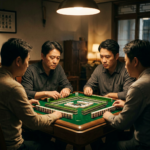
How to Play Defense in American Mahjong (and Stop Handing Opponents the Win)
Most beginners think the game is about the hand in front of them. You draw, you discard, you chase the pattern on your card. That part is real, and it’s the fun part. But here’s what nobody tells you until you’ve lost a few games you should have won: a lot of American mahjong is defense. Your discards feed the other three players. Every tile you throw is a small gift to somebody at the table. Play defense well and you’ll win games you had no business winning. Play it badly and you’ll watch your neighbor call mahjong off a…
-
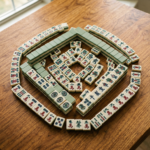
What’s Actually in an American Mahjong Set? A Plain Tour of Every Tile
Open a new American mahjong set for the first time and it looks like somebody dumped a small library of tiny ivory bricks on your table. There are characters you don’t read, numbers you half recognize, dragons, flowers, and a handful of tiles that look like they belong to a different game entirely. One hundred and fifty-two of them. Nobody tells you on the box where to start. So here’s the start: most of those tiles belong to one of three suits, a smaller pile are what players call the honors, and a few are special. Walk the set once…
-
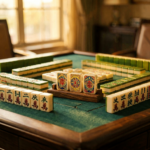
Jokers in American Mahjong: What They Can Do, What They Can’t, and When to Let One Go
Ask four American mahjong players what makes their game different from every other version played around the world, and you’ll get four answers. But the honest one is short: jokers. Eight of them, sitting in the wall, quietly deciding who wins. They’re also the tiles new players get wrong most often. Not because the rules are complicated, but because jokers feel like they should be more flexible than they actually are. So let’s go through what a joker really does, where it stops working, and the judgment calls that separate a decent player from a good one. Eight tiles that…
-

American Mahjong at Work: How to Run a Team-Building Session People Actually Enjoy
You booked the room, ordered the food, and now you need an activity that won’t make people fake a headache. Most team-building ideas fall into two buckets: too competitive or too embarrassing. American mahjong lands in a third, much better bucket. It’s a real game with real decisions, but you can play it half-asleep on a Friday, and nobody needs to be athletic, loud, or good at PowerPoint. Here’s how to run one that your team talks about for the right reasons. Why this game, specifically Most office games break down for the same reason: someone dominates, or nobody understands…
-

Can You Play American Mahjong With 2, 3, or 5 Players? What Actually Works
The rule says four players. The group chat says three people are free on Thursday. Or it’s just you and your partner, and you’d still like to touch the tiles. This comes up more than the official rules admit. American mahjong is written for a table of four, but most of us don’t live in a four-person world. So the real question isn’t “is this legal” — it’s “does it still feel like the game.” Here’s what I’ve seen actually work. Four is the design, but the game bends Standard American mahjong uses 152 tiles and a fixed rotation of…
-
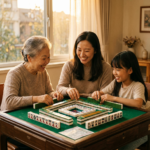
Three Generations, One Mahjong Table: How to Get Kids, Parents, and Grandparents Playing Together
My favorite thing about American mahjong isn’t the strategy. It’s the fact that a seventy-eight-year-old and a thirteen-year-old can sit at the same table and both be genuinely interested. Not one of them politely humoring the other. Both of them in it. That’s rarer than it sounds. Most family games split by age. Board games get too simple for adults or too fiddly for kids. Card games turn into gambling or math homework. Mahjong somehow lands in the middle: enough pattern-matching to keep a grandmother sharp, enough noise and shuffling and luck to keep a teenager from wandering off to…
-

The Etiquette of American Mahjong: Unwritten Rules That Keep the Table Friendly
You can learn the rules of American mahjong in an afternoon. The card, the Charleston, the jokers — none of it is that hard once someone walks you through it. But there’s a second layer that nobody prints on the rule sheet, and it’s the part that decides whether people actually want to play with you again. It’s etiquette. The little unwritten habits that keep four strangers, or four friends, at the same table for three hours without anyone wanting to flip the board. If you grew up with the game, a lot of this is muscle memory. If you’re…
-
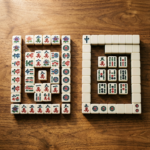
American Mahjong vs. Japanese Riichi: Two Totally Different Games With the Same Tiles
Walk into any game shop and you’ll see them sitting side by side — same little rectangles, same dragons and winds, same satisfying clack when you shuffle. But here’s the thing nobody tells you up front: American mahjong and Japanese riichi are not the same game wearing different clothes. They share an ancestor and a tile set that looks familiar, and then they go completely their own way. If you’ve only ever played one, the other will feel like learning chess after years of checkers. American tiles carry extra suits, flowers, and those all-important jokers. How American mahjong actually plays…
-
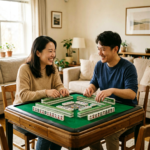
Why American Mahjong Is Good for Your Brain and Your Social Life
You think you are just playing a game. Two hours pass, you look up, and you have laughed more than you did all week. The tiles are still warm from your hands. Something about American mahjong does that to people, and it is not only the winning. Players have been saying mahjong is good for you for a hundred years, usually in the same breath as crossword puzzles and a good walk. The difference is that mahjong asks for your hands, your eyes, your memory, and three other people at the same time. That combination is rarer than it sounds,…
-
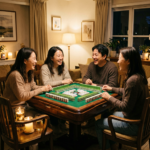
How to Host an American Mahjong Night Your Friends Will Actually Want to Repeat
You sent the text. Four people said yes. Now what. Hosting an American mahjong night sounds more intimidating than it is, mostly because everyone assumes they need to be a tournament player before they are allowed to own a table. You do not. You need a set, a card, and a plan that keeps people laughing instead of googling the rules under the table. The hosts who pull it off almost never do the thing beginners fear most: they do not run a class. They set up the room, hand people the card, and let the game teach itself while…